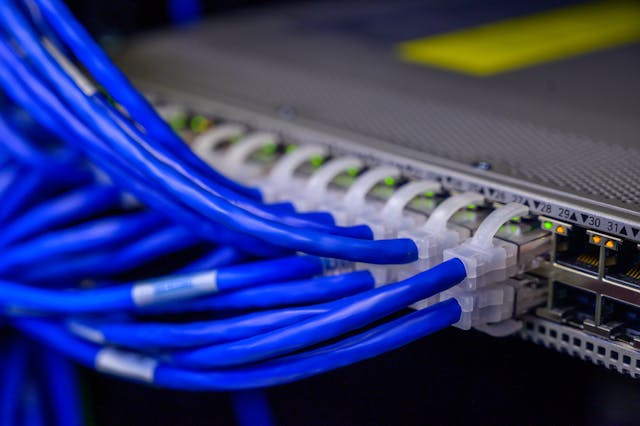
Germany sits in the middle of Europe’s fiber backbone, which is why a German dedicated server draws traffic from Frankfurt trading desks, Amsterdam retail sites and Warsaw game lobbies with similar one-way delay figures. What you rent in Hamburg is not the same product as what you rent outside Berlin, and the provider checklist matters more than the city name on the order form.
This guide covers the three things buyers actually get wrong: treating “Germany” as one location, ignoring how upstream transit shapes routes into Eastern Europe and the Nordics, and signing a contract without confirming who owns the hardware and the network. Everything below is written for 2026 pricing and hardware generations.
Why Germany Is a First-Choice Region for European Traffic
Germany hosts the largest concentration of carrier-neutral internet exchanges in Europe. DE-CIX Frankfurt is the biggest by peak traffic, and Berlin, Hamburg, Düsseldorf and Munich all run substantial exchange fabrics of their own. A server cross-connected to one of those fabrics reaches most European capitals in under 20 milliseconds round trip and reaches the US East Coast in roughly 75 to 85 milliseconds.
The practical consequence is that a dedicated machine in Frankfurt can serve an e-commerce catalog for German, Austrian and Swiss customers without any edge layer at all, and it can serve a game server for players across the Benelux and Czech Republic with tick times that stay stable. Budget for the fact that power in Germany is not cheap, and providers who quote unusually low prices in Frankfurt are usually reselling a slice of someone else’s allocation.
Reading a German Data Center Listing: Cities, Zones, and What Each Implies
Frankfurt is the interconnection hub. It has the deepest transit selection, the most peering options and the most providers competing for the same cage space. It is the right default if your traffic is pan-European or you need private cross-connects to cloud on-ramps. Berlin has grown quickly as a secondary hub, with strong fiber into Poland and the Baltic states, and tends to price slightly below Frankfurt.
Hamburg serves northern Germany and Düsseldorf the west, while Munich and Nuremberg are the southern options that shorten routes into Austria, Switzerland and northern Italy. A smaller city is not automatically worse, but verify the carrier list first, because a facility with two upstreams and no exchange presence will show jitter at peak hours.
Ask which facility and which zone, not just the country. Redundant power and 24/7 on-site hands are baseline expectations; a provider who cannot name the site or the tier should be treated as a broker until they prove otherwise.
Latency Math for German Hosting: What Realistic Numbers Look Like
Useful planning figures for a well-connected Frankfurt server: 1 to 5 ms to local German cities, 8 to 15 ms to Amsterdam, Paris, Zurich and Prague, 15 to 25 ms to Stockholm, Madrid and Warsaw, 20 to 30 ms to London, and 75 to 90 ms to New York or Ashburn. Anything materially worse than these bands points to a routing problem rather than a physics problem.
Latency is not the whole picture. Jitter and packet loss matter more for real-time workloads than a few extra milliseconds of median delay, so ask for a looking-glass and run MTR from three networks for fifteen minutes. If the route into a target country doglegs through London or Amsterdam when a direct peer exists, the provider buys cheap transit instead of peering locally.
Bandwidth, DDoS Filtering, and the German Regulatory Picture
Most German dedicated offers include between 10 and 30 TB of monthly traffic on a 1 Gbps port, with 10 Gbps ports available at a premium. Unmetered plans exist but usually mean a capped port speed rather than literally unlimited transfer. Read the fair-use clause before you assume unmetered means you can push a full gigabit around the clock.
DDoS protection is the other differentiator. Volumetric filtering is common in German facilities because the exchange fabrics make scrubbing centers easy to attach, but quality varies from always-on inline mitigation to on-demand rerouting that takes minutes to engage. For game servers and public sites, always-on filtering with a documented threshold is worth paying for.
German data protection rules are strict and well documented. If you handle personal data from EU residents, a provider that can supply a data processing agreement, name its subprocessors and state retention policies for connection logs is easier to work with than one that answers vaguely. A provider who cannot produce the paperwork at the sales stage will not produce it during an audit.
Hardware You Should Expect in 2026
Entry dedicated machines now typically pair an AMD EPYC 4004 or 8004 series chip, or an Intel Xeon E-2400 class processor, with 32 to 64 GB of DDR5 and NVMe rather than SATA SSDs. Dual-socket EPYC 9004 and 9005 platforms with 256 GB or more of memory are the norm for virtualization hosts and busy database nodes.
Check the storage topology, not just the drive count: two NVMe drives in hardware RAID 1 through a cached controller behave very differently from software RAID under load. Ask whether the cache is battery or capacitor backed, whether the drives are enterprise-grade with power-loss protection, and whether you get IPMI or iDRAC with virtual media. Remote console access is the single most useful feature on a dedicated box, turning an unresponsive server from a support ticket into a ten-minute fix.
The Provider Checklist Before You Sign
Work through this list in order and accept no verbal assurances. Confirm the legal entity and registered address, name the facility, city and redundancy tier, get a test IP and trace routes from your real user networks, request the carrier and peer list, and confirm what DDoS mitigation exists and whether it is always on.
Then cover the commercial and operational side: the bandwidth allotment and overage rate, the minimum term, the notice period, and whether the price is fixed for the term. Ask how hardware replacement works, what the guaranteed response time is, and whether remote hands are billed hourly or included. Finally, confirm you receive full administrative access, including the ability to reinstall the operating system yourself.
Where a German Dedicated Server Fits and Where It Does Not
A German dedicated server is right when users are mostly in Europe, when you need predictable single-tenant performance for databases or game worlds, and when direct peering with networks that matter is useful. It is wrong if your audience is overwhelmingly in Asia or South America, where local facilities win on distance, or if demand is short-lived and spiky, where cloud billing beats a monthly commitment.
For buyers comparing options, the useful next step is to line up two or three German providers against the checklist above and let the route traces decide. Start from a shortlist built around confirmed facility locations and carrier diversity, review the dedicated server hosting options available for European regions, and compare the hardware tiers against the current dedicated server plans before committing to a term. The provider that answers the technical questions without hesitation is almost always the one that will answer a support ticket at 3 a.m.
Related Articles:
 Valheim Dedicated Server Hardware: Specs, Setup, and Tuning for 2026
 Rust Dedicated Server Performance Guide: Hardware Configs and Tuning for 2026
 Dedicated Server for Modded Minecraft: How Much RAM and CPU Do Heavy Modpacks Really Need?
 Unturned Dedicated Server Hosting: Hardware Specs, Setup, and Optimization for 2026
Leave a Reply
You must be logged in to post a comment.